
Grandeur Trails of Gujarat
ITINERARY OVERVIEW
09 DAYS / 08 NIGHTS
DAY 01 :BY AIR I TRAIN – ARRIVE RAJKOT FOLLOWED BY ROAD – 250 KMS I 05 HRS – RAJKOT TO DWARKA
Arrive Rajkot and drive to Dwarka, arrive and transfer to your hotel.
The small coastal town of Dwarka is one of the four most holy Hindu pilgrimage sites in India. It is here that Krishna founded his capital after leaving Mathura. Excavations have revealed 5 earlier cities at the site, all submerged. The present town dates largely to the 19’h century and attracts thousands of pilgrims to celebrate the Hal Diwali and Janmashthami festivals. The multi pillared Sabha Mandapa leads to a 60-pillared sanctum sanctorum that dates back 2500 yea rs as per the scriptures.
Overnight at hotel
DAY 02 :IN DWARKA
After breakfast visit Gomti Ghat – A significant tributary of the river Ganges, the Gomti River is the most revered waterbody in the Hindu faith. The mouth of the Gomti river sites the Gomti Ghat, which requires about 56 stairs to reach from t he Dwarkadhish Temple. The serene ghat location is great for some photo ops. Besides, it also makes for a pilgrimage too, as many devotees take a sacred dip in the salty waters of the Gomti river.
Later visit Dwarkadhish Temple – The main draw for tourists coming to Dwarka, the Dwarkadhish Temple (Jagat Mandir), is believed to have been established more tha n 2500 years ago by Lord Krish na’s great grandson, Vajranabh. The ancient temple has been renovated several times, especially leaving imprints of 16th and 19th centuries. The temple
stands on a small hill accessed by 50 plus steps, with heavily sculptured walls that cocoon the sanctum with the main Krishna idol Around the com plex lie other smaller shrines. The walls have intricately carved mythical characters and legends. The impressive 43 m high spire is topped with a flag made from 52 yards of cloth that flutters in the soft breeze from the Ara bian Sea behind the temple. There are two doors (swarg and moksha) for the entry and exit of the temple. A bridge called Sudama Setu (7am-1pm, 4-7.30pm) at the base of the temple takes one across the Gomti creek towards the beach.
Later visit The Rukmini temple, dating from 12 to 13 Century, was built in honour of Rani Rukmini princess of Vidharba, who was to be married to Sishupala, but fled with Lord Krishna. This small temple, 1.5 km north of the city, is an architectural masterpiece. The temple walls are decorated with beautiful paintings and sculptures.
Later visit Bet Dwarka: A small island off the coast of Dwarka and accessed via Okha is home to the namesake temple, and supposedly the residence of Lord Krishna when he arrived here. The establishment of the temple is credited to Guru Vallabh Acharya. Apart from the main temple, others in the complex commemorate Hanuman, Vishnu, Shiva, Lakshmi Narayan, Jambavat Dev and others. Bet Dwarka, also known as Shankhoddhar, is said to have been the residence of Lord Krishna during his ruling years at Dwarka. It derived its name from the word ‘bet’ which translates to ‘gift’ and is believed that Lord Krishna received it from his friend Sudama. In the ancient epic, Mahabharata, Bet Dwarka is known by the name of ‘Antardvipa’ to which people of the Yadava clan needed to travel by boat.
Nageshwar Temple or Nagnath Temple is located on the route between Gomati Dwarka and the Bet Dwarka Island on the coast of Saurashtra in Gujarat. The Jyotirlinga enshrined in the Temple of Nagnath is known as Nageshwar Mahadev and attracts thousands of pilgrims all-round the year. This powerful Jyotirlinga symbolizes protection from all poisons. It is said that those who pray to the Nageshwar Lingaa become free of poison. The Rudra Samhita shloka refers to Nageshwar with the phrase ‘Daarukaavane Naagesham’.
Gopi Talav: This is the place where Lord Krishna used to play with his Gopikas. There is a small pond where it is said that Lord Krishna used to play with the Gopika Strees (Gopika Women).
Bhadkeshwar Mahadev Mandir, dedicated to Lord Shiva, is an ancient temple, some 5000 years old, which was built around a self-manifested Shivaling found in the Arabia n Sea. The temple gets submerged in the sea every year during monsoons, which devotees believe to be nature’s way of performing the religious process of Abhishekam. For the rest of the year, the temple is visited often for its divine vibe and the scenic beauty of the attraction.
Overnight at hotel
DAY 03 :IN DWARKA
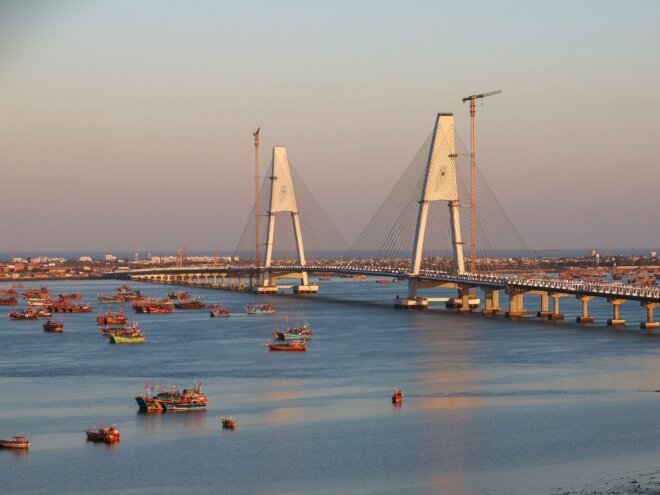
After breakfast visit Sudama Setu Bridge is a stunning suspension bridge built for pedestrians to cross River GomtL The bridge was named after Sudhama, Lord Krishna’s childhood friend. Sudhama Setu connects the ancient Jagat Temple and the sacred Panchkui Teerth on the island which is associated with the legendary Pandava brothers. Besides mythology, the bridge is also famous for a breath-taking view of the river and the Arabian Sea. There are ample seating arrangements here to enjoy the view.
Later visit Shivrajpur Beach, which is Blue Flag beach and is situated 12 kilometres from Dwarka (Gujarat) along the Dwarka-Okha Highway. Shivrajpur Beach, one of Gujarat’s most well-known beaches, is the ideal place to spend time with family and children. You mig ht be fortunate enough to catch a glimpse of dolphins or other lovely birds. This long, pristine beach stretches near the Shivrajpur village, between a lighthouse and a rocky shoreline. It is ideal for a long walk. Immerse yourself in a variety of adventure activities with friends and family like snorkeling, scuba diving, island tours, sea bathing, or sit by the silent sea and watch the sun bid adieu to the day!
Overnight at hotel
DAY 04 :BY ROAD- 250 KMS / 05 HRS – DWARKA TO SOMNATH
After breakfast drive to Somnath en route visit Mui Dwarka, Jambuvan Caves, Krishna & Rukmani Vivaah Place, and Madhavpur Beach.
Mui Dwarka :While going from Mathura to Dwarka Lord Krishna had stopped in Porbandar at village Visavda. In its remembrance in Visavda (Mui Dwarka) Lord Krishna’s “paduka” can be seen in this temple.
Jambuvan Cave : Also known as Jambavant Cave or Jambuvant ki Gufa, this cave was the resting place of the warrior Jambuvan, who had his own special role in both the Hindu epics Ramayana and Mahabharata. It is believed that this is the place where Lord Krishna and Jambuvan fought for the Syamantaka jewel for 28days.
Krishna-Rukmini Vivaah : Madhavpur Ghed is a small village where Lord Krishna married Sri Rukmini Ji after kidnapping her from Amravati in Vidarbha. This is a very beautiful village close to Porbandar (60 km) and lies on the seashore. There is an exact spot where Lord Krishna married Rukmini Ji.
Visit Madhavpur-A scenic town, Madhavpu r is situated on a sandy coastline and is endowed with coconut trees and fertile agriculture la nd. It hosts the beautiful Madhavraiji Haveli Temple in addition to the Rukmini no chore, which marks the place were celebrated with an annual fair held by the Mer community. Nearby are the ruins of a shiva temple, probably from the 12thc.The beach is not safe for swimming, but perfect for taking in the sea breeze.
Porbandar,the coastal heritage town of Gujarat is located on the Saurashtra peninsula, on the Arabian Sea. This city is described in Skanda Purana as Sudamapuri and Ashmavati and had a flourishing trade with Africa and Arabia. As per the legends, this city was the main link of the great friendship between Lord Krishna and Sudama. Porbandar was established as a capital by Rana Sartanji in 1785 AD. Porbandar was the former capital of the Jethwa Rajput petty princely state. The most impressive feature of Porbandar is the city planning and the stone buildings with ashlar masonry and rich carving, the facades of the houses on either side of the streets, with windows and carved gateways. Porbandar is also associated with Mahatma Gandhi, the father of nation as he was born here. Today, fine quality silk and cotton are manufactured here. There are also chemical factories and cement works.
Later visit Kirti Mandir – Kirti Mandir was the house of the Mahatma Gandhi and Kasturba, his wife. This place is situated near the place where the Mahatma Gandhi was born. This place is now a small museum and has a Gandhian library and a prayer hall.
Also, visit Sudama Dwarka Temple, this temple is dedicated to Sudama who was the child hood friend of Lord Krishna. Located at the center of Porbandar, it is one exceptional temple in India which is dedicated to this great devotee of Lord Krishna. Built with white marble this temple has several carved pillars which decorate the temple, open from all sides this temple has a shikhara which is decorated with splendid architecture and carvings. These carvings are also visible above the pillars and the arches which adjoin the pillars. With such architecture, this temple is dedicated to the shrine of Sudama which is built in simple structure.
Later continue to drive to Somnath; arrive Somnath and transfer to you r hotel.
Somnath consists of a few streets leading away from its phoenix like temple. The rugged sea below gives it a lonely, wistful charm. The pilgrim trade is constant, but merchants are relaxed, perhaps in deference to the shadows cast by the awe-inspiring temple. Somnath is mainly known for the legendary shore temple of Somnath, which is dedicated to the Lord Shiva.
Overnight at hotel
DAY 05 :IN SOMNATH
Early Morning visit the intricately carved honey-coloured Somnath temple on the western edge of the state is believed to be the place where the first of the twelve holy jyotirlingas emerged in India -a spot where Shiva appeared as a fiery column of light. The temple lies at the meeting of Kapila, Hiran and Sarasvati rivers and the waves of the Arabian Sea ebb and flow touching the shore on which it is constructed. The ancient temple’s timeline can be traced from 649 BC but is believed to be older than that. The present form was reconstructed in 1951.Colourful dioramas of the Shiva story line the north side of the temple garden, though it’s hard to see them through the hazy glass. A one hour sound-a nd-light show in Amitabh Bachchan’s baritone highlights the temple. (Subject to weather conditions)
It’s said that Somraj (the moon god) first built a temple in Somnath, made of gold; this was rebuilt by Ravana in silver, by Krishna in wood and by Bhimdev in stone. The current serene, symmetrical structure was built to traditional designs on the original coastal site: it’s painted a creamy colour and boasts a Little fine sculpture. The large, black Shiva lingam at its heart is one of the 12most sacred Shiva shrines, known as jyotirlinga.
Ahilyabai Temple is a Hind u temple located in Somnath. Situated opposite to the famous Somnath Temple, it is one of the old and beautiful temples in Somnath. Dedicated to Lord Shiva, Ahilyabai Temple was built by Maratha queen Ahilyabai Holkar in 17th century. The history of Ahilyabai Temple and Somnath Temple is closely interlinked. It is said that this temple was constructed asa substitute for the main Somnath Temple when it was raided and ravaged by the Muslim rulers. It is also said that the location of the Swayambhu Unga came in Ahilyabai’s dreams post which she started the construction im mediately. Many Hindus believe that Ahilyabai Temple contains the original Jyotirlinga which was hidden here assuming that the original Somnath Temple is going to be raided.
Laxminarayan Temple – Located on the Somnath shore, the presiding deity, Lord Laxminarayan is an incarnation of Lord Vishnu. Reflects modern architectural design, this tem ple is famous for the carvings on its 18pillars which have the sacred message of Krishna in the form of Bhagwad Gita.
Triveni Sangam Temple -The confluence of the th ree rivers Hiran, Kapila and Saraswati this is the point where the rivers meet the mighty Arabian Sea. Triveni Sangam is believed to be a very sacred Moksha Tirtha for Hind us.
Bhalka Teerth is a renowned Hindu pilgrimage center believed to be the place where Lord Krishna was shot by a hunter’s arrow. The teerth has a temple dedicated to Lord Krishna called Mahaprabhuji Baithak.
Dehotsarg Teerth is an important pilgrim centre for the Hindus as this is where Lord Krishna breathed his last after he was shot by Jara’s arrow. The location is marked by Lord Krishna’s footprints and this incident is elaborated in the sacred texts as Sri Krishna Neej-dham Prasthan Leela. It is also believed that Krishna’s brother, Baldev, also accompanied him in the form of a serpent crawling through the Balramji ki Gufa nearby.
Attend the evening aarti at Somnath temple. After performing the evening Aarti at Somnath temple and after witnessing the Sound & Light Show (Direct Payment) then visit the beach of Somnath which is very beautiful & a captivating sight to behold. The fresh blue waters, humming waves and the cool sands give you a feeling of having landed in a paradise. The beach has pleasant sand, great sea views, camel and pony rides, coconut stalls and snack places.
Overnight at hotel
DAY 06 :BY ROAD – 65 KMS / 01 HR – SOMNATH TO SASANGIR
After breakfast drive to Sasangir, arrive and transfer to your hotel.
Sasan Gir; popularly known as Gir; the most famous lion sanctuary in India. And the one place in the subcontinent where Asiatic Lions can be found in the wild. This forested, hilly, 1412-sq-km sanctuary about halfway between Veraval and Junagadh is the Last refuge of the Asiatic Lion (Panthera leopersica). Taking a safari through the thick, undisturbed forests is a joy – even without the added excitement of spotting lions, other wildlife, and myriad bird species. Access to the sanctuary is by safari permit only.
If you miss out on a permit, your other option for Lion encounters is at the Deva Lia Safari Park, a fenced-off pa rt of the sanctuary where sightings are guaranteed but more stage-managed. The sanctuary’s 37 other mammal species, most of which have also increased in numbers, include dainty chital (spotted deer), sambar (large deer), nilgais (blue bull I Large antelopes), Chowsingha (four-horned antelopes), chinkaras (gazelles), crocodiles and rarely seen leopards. The park is a great destination for birders too, with more than 300 bird species, most of the residents.
Overnight at hotel
DAY 07 :IN SASANGIR
Today enjoy morning & afternoon safari into Sasan gir wild life sanctuary.
[Subject to availability and prior to permission and 100% permits will avail by online only. The online window will open 90 days prior to visit date.]
Overnight at hotel
DAY 08 :BY ROAD- 60 KMS I 01 HR – SASANGIR TO JUNAGADH
After breakfast drive to Junagadh, arrive and transfer to your hotel. Junagadh literally means ancient fort was once the capital of the Junagadh state, under the Muslim rulers of Babi Nawabs. Junagadh town is located at the foothills of the sacred hill of Girnar and occupies a special place in the history of Gujarat.
Later visit Durbar Hall Museum – Durbar Hall Museum houses a large collection of silver chains, chandeliers, thrones, palanquins, weapons, and armour from the days of the Nawabs. There is also a portrait gallery of the Nawabs. This museum was once the hall where the Nawabs held their Darbars (assemblies).
Ashoka’s Rock Edicts belong to 250 BC where around 14 edicts of Ashoka are Located on the route to the Mount Girnar Hills. This rock edict is a huge stone and the carving in Brahmi script in Pali language mentions the resistance to greed and animal sacrifice and moralizes the principles of purity of thought, secularism in thinking, kindness, and gratitude. The other major part of Junagadh’s Buddhist heritage are the stone edicts of Emperor Ashoka, found on the road towards Mt. Girnar.
Later visit Mount Girnar: Girnar Mountain is about 1100m (3630ft.) high and is an extinct volcano. It is said that Mount Girnar was once a flying mountain. It is 4km east of Junagadh and is the main tourist attraction in the area. Mount Girnar is one of the hills in Ahmedabad which is most sacred to the Jain community. This hill rises to a height of more than 600 m, a clim b marked by 10,000 stone-steps. On this hill various Hindu and five Jain temples are Located. There is a group of 16 Jain temples on the hill. This sacred hill is visited by millions of Hindus and Jains. The Amba Mata temple is situated on the top of the hill. One of the Largest and the oldest Jain temple, dedicated to the Neminath, the 22nd Jain Tirthankar and the Mallinath, the 19th Jain Tirthankar are situated just below the Amba Mata temple. This temple was bu ilt in the 12th century. Besides this the Bhavnath temple dedicated to the Lord Shiva is also on the hill
Rope way Tickets to Mount Gimar is NOT INCLUDED. Can be booked directly from https://uda nkhatola.com
Overnight at hotel
DAY 09 :BY ROAD – 100 KMS I 02 HRS – JUNAGADH TO RAJKOT FOLLOWED BY AIR I TRAIN- DEPART RAJKOT
After breakfast drive to Rajkot en route visit Gondal.
Gondal: The Riverside palace at Gonda a govt. of India classified heritage hotel and the Orchard Palace in the same town, are two mansion guest houses opened as heritage hotels. The interiors of these properties are appointed with period furniture, antiques, and artifacts reminiscent of the days of the Raj. The highlight of staying at these properties is that guests can seethe Royal Garages, housing vintage and classic cars, and the Naulakha Palace, which is a festival of stone carvings and houses royal memorabilia including toys of the Late 19th and early 20th century, silver caskets that carried messages and gifts for the Maharajah, elephant howdahs and royal portraits. It has a royal saloon suite, which has its own drawing, dining, bedroom, and bathroom in a converted railway carriage.
Later arrive Rajkot and in time transfer to Rajkot Airport I Railway Station to board a flight I train for your next destination .