
Footprints of Mahatma Gandhi
ITINERARY OVERVIEW
05 Nights = 06 Days
DAY 01 :BY AIR I BY TRAIN – ARRIVE RAJKOT
Arrive in Rajkot and transfer to your hotel.
Rajkot was the former capital of the princely state of Saurashtra. Rajkot was once a base for the Western States British government office and rapidly expanded into a prosperous, lively business centre, with an old city. This city is also associated with the Mahatma Gandhi who lived here for several years. His father was the Dewan (Chief Minister) of Rajkot, once a small princely State.
Later visit – Kaba Gandhi No Delo / Mahatma Gandhi House – The Kaba Gandhi No Delo is the house of Mahatma Gandhi where he lived from the age of six. The Mahatma Gandhi House has a good collection of things related to Mahatma Gandhi’s life. The Mahatma’s Passion for the hand loom is preserved in the form of a small weaving school.
Watson Museum – The Watson Museum and Library commemorates the work of Colonel John Watson, political agent from 1886 to 1889. It is a jumbled attic of the collection with the 3rd century inscriptions and a delicate ivory work overseen by a marble statue of Queen Victoria. The Watson Museum has a collection of precious objects of colonial period, hu ma n history and culture, and History of Rajkot.
Rajkumar College – The world famous Rajkumar College is in the city. This college dates to the 19th century and is regarded as one of India’s best private colleges. It was set up by the British for the education of the princes of the Indian state.
Overnight at hotel
DAY 02 :BY ROAD- 195 KMS / 04 HRS – RAJKOT TO PORBANDAR
After breakfast drive to Porbandar; arrive and transfer to your hotel.
Porbandar, the coastal heritage town of Gujarat is located on the Saurashtra peninsula, on the Arabian Sea. This city is described in Skanda Purana as Sudamapuri and Ashmavati and had a flourishing trade with Africa and Arabia. According to the legends, this city was the main link of the great friendship between Lord Krishna and Sudama. Porbandar was established as a ca pital by Rana Sartanji in 1785 AD. Porbandar was the former capital of the Jethwa Rajput petty princely state.
The most impressive feature of Porbandar is the city planning and the stone buildings with ashlar masonry and rich carving, the facades of the houses on either side of the streets, with windows and carved gateways. Porbandar is also associated with Mahatma Gandhi, the father of nation as he was born here. Today, fine qua lity silk and cotton are manufactured here. There are also chemical factories and cement works.
Later visit Kirti Mandir – Kirti Mandir was the house of the Mahatma Gandhi and Kasturba, his wife. This place is situated near the place where the Mahatma Gandhi was born. This place is now a small museum and has a Gandhian library and a prayer hall.
Bharat Mandir Hall – Bharat Mandir Hall is situated in a pleasant, irrigated garden. This hall has a large relief map of India on the floor and bas reliefs of heroes from Hind u legends on the pillars.
Overnight at hotel.
DAY03:BYROAD-375KMS/07HRS-PORBANDAR TO BHAVNAGAR
After breakfast drive Bhavnagar and transfer to your hotel
Bhavnagar was founded by Bhavsinhji Gohil in 1723AD near the Gulf of Khambhat, on a carefully chosen strategic location having potential of maritime trade. Till independence, Bhavnagar State was ruled by the Gohil Rajput clan. This city is also associated with the Mahatma Gandhi, who went to the Bhavnagar university.
Later visit The Gandhi Smriti and Barton Museum, which is located in the northeast, by the dock tower and has a good collection of Gandhi memorabilia.
Gaurishanker Lake: A beautiful picnic spot near the lake. There is also a well laid out park. Takhteshwar Temple: Situated on a hill the site provides a panoramic view.
Lock Gate: The first of its kind in Gujarat. The seawater here is impounded by the lock gates to keep ships afloat during low tide, which could be seen with special permission.
Overnight at hotel.
DAY04: BY ROAD-200KMS/04 HRS-BHAVNAGAR TOAHMEDABAD
After breakfast drive to Ahmedabad; en route visit Lothal.
Lothal: A perfect place to get an insight into the Indus Valley civilization. The most dominating site at Lethal is the massive dockyard spanning an area of 37 meters by 22 meters perhaps the greatest work of Ma ritime Architecture. Lethal was also famous for its arterial streets, microbes of gold, ivory and coppersmiths’ workshops, potteries, and underground sanitary drainage.(Closed on Fridays).
Later continue to drive to Ahmedabad; arrive and transfer to your hotel
Ahmedabad is Located on the banks of the river Sabarmati the city was founded by Sultan Ahmad Shah in 1411. Today it is one of the fastest growing cities of I nd ia and is an immense repository of tradition, history & culture. Its famous walled area is one of the finest examples of community living & the city thrived as the textile capital & was nicknamed “Manchester of the East’ in 1888. This multicultural city is home to some of the finest Indo-Saracenic mosques &Jain temples.
The old city of Ahmedabad is dotted with labyrinthine by-lanes called ‘polls’.The exquisite carved wooden mansions and havelis are in no manner less than their stone counterparts in Rajasthan. The city also offers a rich architectural legacy that blends Hind u and Muslim schools of architecture, stone and brick with arches, domes and vaults, carved pillars, trefoil designs besides the modern buildings designed by the famous French architect, Le Corbusier and Louis Kahn.
Evening Market at Law Garden displays beautiful textile handicrafts of Gujarat.
Dinner at Vishalla :Vishalla is a restaurant with traditional Gujarati food in village surroundings. It has Veechar Utensil Museum worth visiting. The museum houses a unique collection of utensils. Museum remains closed on Mondays.
A walk around the hut-like museum makes one’s heart skip a beat, marveling at the inimitable beauty of these utensils of old. These utensils have been handed down through the changing seasons and times, over the years. They speak of the unmatched art and genius of humankind during the days of old when people did not have the modern facilities of our times. The designer could not let our rich heritage pass with these vessels being lost in the fire kilns! He was determined to preserve them, and today, his dream is a reality in the form of Vechaar.
Overnight at Ahmedabad.
DAYO5 :IN AHMEDABAD
Today we start our day with morning heritage walk of Ahmedabad.
Heritage Walk :The Heritage Walk of Ahmedabad is a guided walk of two and a half hours. Called Mandir se Masjid tak, the two-kilometre walk held everyday with 40 sights originally, begins from the Swami-narayan temple built in 1822 in the Kalupur area, said to be the first temple of the sect, and ends at the Jami Masjid, built in 1424 AD in Teen Darwaza area.
Later we go for city tour of Ahmedabad.
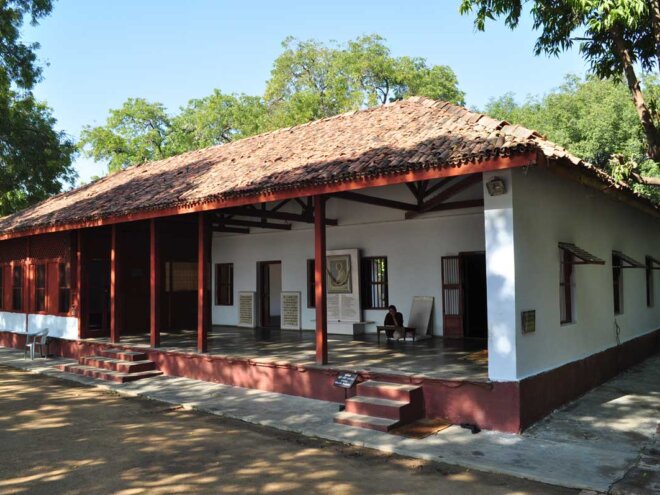
Gandhi Ashram: On a quiet peaceful stretch of the Sabarmati River, Mahatma Gandhi set up a simple retreat in 1915. This was his Satyagrah Ashram and for many years it was the nerve centre of India’s freedom movement. It was from here, in 1930, that Mahatma began his famous Dandi March to the sea to protest the Salt Tax imposed by the British. Hridaya Kunj, the simple cottage where he lived, is now a national monument and preserved as it was du ring the Mahatma’s lifetime.
Sidi Sayed Mosque: One part of the wall in the old citadel of the mosque built by Ahmed Shah’s slave, Sidi Sayed, is celebrated the world over for its exquisite stone window tracery -a superb & peerless example of delicate carving that transforms stone into filigree.
Hutheesingh Jain Temple: Built outside the Delhi Gate in 1850 by a rich Jain merchant, the Hutheesingh Temple is the best known of Ahmedabad’s many ornate Jain temples.
Adalaj Step-well Adalaj is situated about 17kms. north of Ahmedabad. The Baoli or step-well at Adalaj Vav is one of the finest steps well in India. Queen Rudabai built this well in 1499 to provide the traveller with a cool and pleasant refuge from the summer heat. It has three entrances leading to a huge platform that rests on 16 pillars, with corners marked by shrines. Ornately carved pillars and cross beams create open spaces and four storey that are quite striking. The octagonal well is five floors deep. The Baoli is decorated with exquisite stone carvings in varied subjects.
Akshardham: Lord Swaminarayan, born in Chapaya in Uttar Pradesh, took a seven-year pilgrimage in Gujarat to preach his religion. He built six temples, the first being at Kalupur in Ahmedabad. Akshardha m, the Swaminarayan temple of Gandhinagar, is a modern complex, built in traditional Indian architectural style from 6,000 metric tons of pink Rajasthan sandstone, carved by expert artisans from Bansipahadpur. The temple is set in a multi-acre garden called Sahajanand Van, with intricate sculptures of Hind u Gods. There is a gold leaf copper sculpture of Lord Swaminarayan .The interiors have beautiful columns in rosewood. Akshardham remains closed on Mondays.
Dandi Kutir : Dandi Kutir is India’s Largest & Only Museum built on the life and teachings of One Man, Mahatma Gandhi. It represents Gandhi’s powerful idea of people across lines of class, gender, age and community asserting their com mon right to salt itself: a symbol to inspire a pluralistic society to march towards independence, Puma Swaraj. Closed on Mondays.
Overnight at hotel
DAY 06 – BY AIR / TRAIN – DEPART AHMEDABAD
In time transfer to Ahmedabad Airport I Railway Station to board a flight I train for your onward journey to your